
TESTING IS UNDERWAY. SIGN UP TO HELP TEST THE SOFTWARE →
For Families & Caregivers

If they ever go missing, your whole community comes running.

Built by a mother who lives this, for families like yours. Autism, Down syndrome, dementia or Alzheimer's, a brain injury, a child who bolts, a grandparent who gets turned around: if someone you love could go missing or go into crisis, DENNIS is for you. Every emergency feature is free.

Why it matters

Wandering is common. The first minutes decide the outcome.

49%of autistic children try to wander or bolt from a safe place after age 4.Pediatrics, 2012
1 in 4of those families had a child go missing long enough to cause real concern.Pediatrics, 2012
71%of documented autism wandering deaths were drownings. Most came after a search of an hour or less.National Autism Association, 2011 to 2016
6 in 10people living with dementia will wander at least once, and many do so repeatedly.Alzheimer's Association
46%of people with dementia who were not found within 24 hours had died, in one Virginia search and rescue study.Koester and Stooksbury, 1995
58%of people with dementia who went missing did so during a normal, permitted activity. This is not a failure of care.Rowe et al., BMC Geriatrics, 2011
Who DENNIS is for

One account for everyone you protect.

Most families caring for one vulnerable person are caring for several people at once. DENNIS gives each person their own profile and their own alert buttons, all under your account.

Autism

A child or adult who bolts

Including people who are nonspeaking, who will not answer to their name, or who are drawn to water, trains, or traffic.

Cognitive and developmental

Down syndrome, intellectual disability, brain injury

Anyone who may not understand danger, may not be able to ask for help, or may not be able to say where they live.

Dementia and Alzheimer's

A parent or grandparent who gets turned around

Someone who goes for a walk and cannot find the way back, or who heads for a job or a home they left years ago.

Other neurological conditions

Any condition that needs extra care

No diagnosis is required. If someone you love could go missing or go into crisis, they belong in DENNIS.

Endangered adults

A vulnerable adult who may be in danger

Including an adult who may be leaving an unsafe situation. For these searches, first responders are brought in to take the lead.

Everyone else at home

Siblings, and you

Add your other children too, including neurotypical kids. Adults can also enroll themselves, so the people who rely on you know what to do if something happens to you.

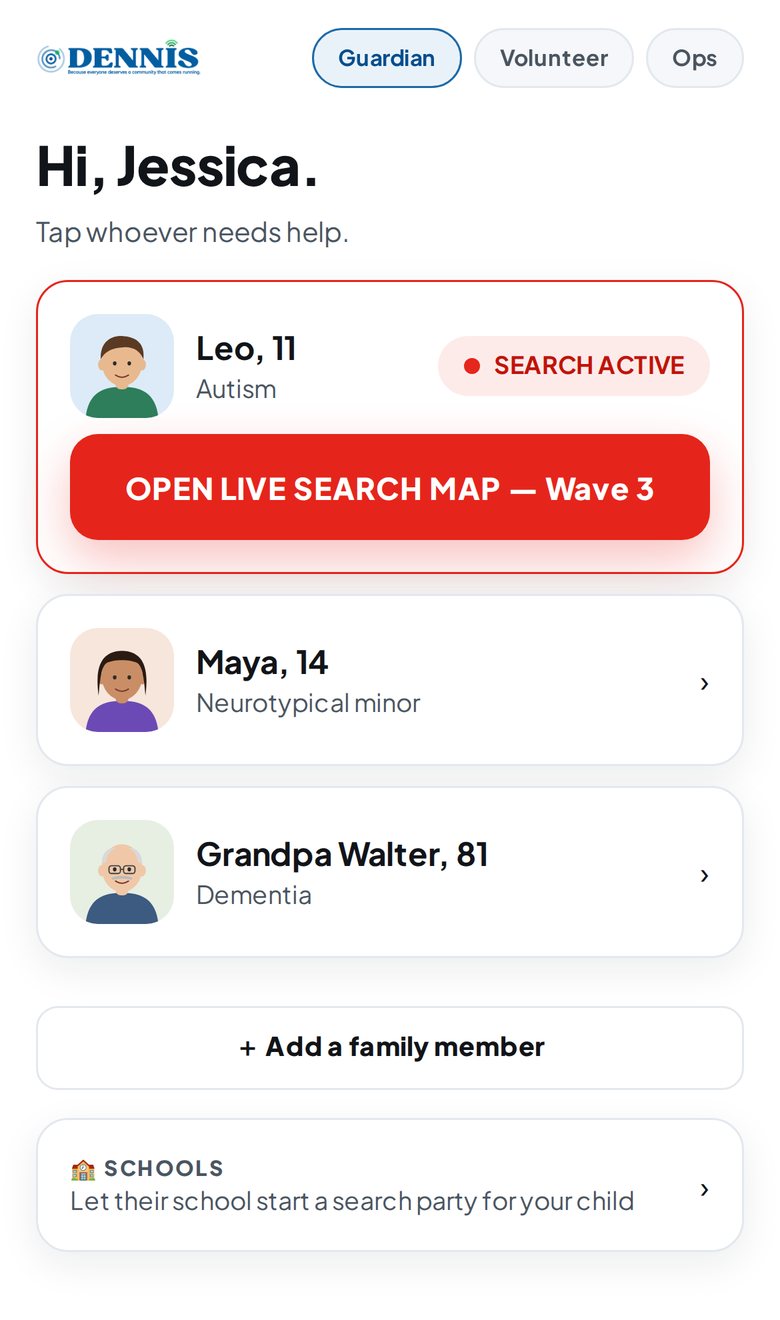
A family's home screen in DENNIS listing three people: an autistic child, a teenage sibling, and a grandfather with dementia
Your family, in one place

Tap whoever needs help.

Your home screen lists everyone you have added. Open a person and you will see two big buttons: Elopement Alert and Assistance Alert. If a search is already running, it shows right there, with a button to open the live map.

  • Each person has their own photo, profile, and alert history.
  • A reminder shows when a flyer photo is out of date, so searchers are never looking for last year's haircut.
  • Every emergency feature is free. Cost should never decide whether a family gets help.

Sample data. The person shown is fictional.

Set up once

Everything a stranger needs to know to help them safely.

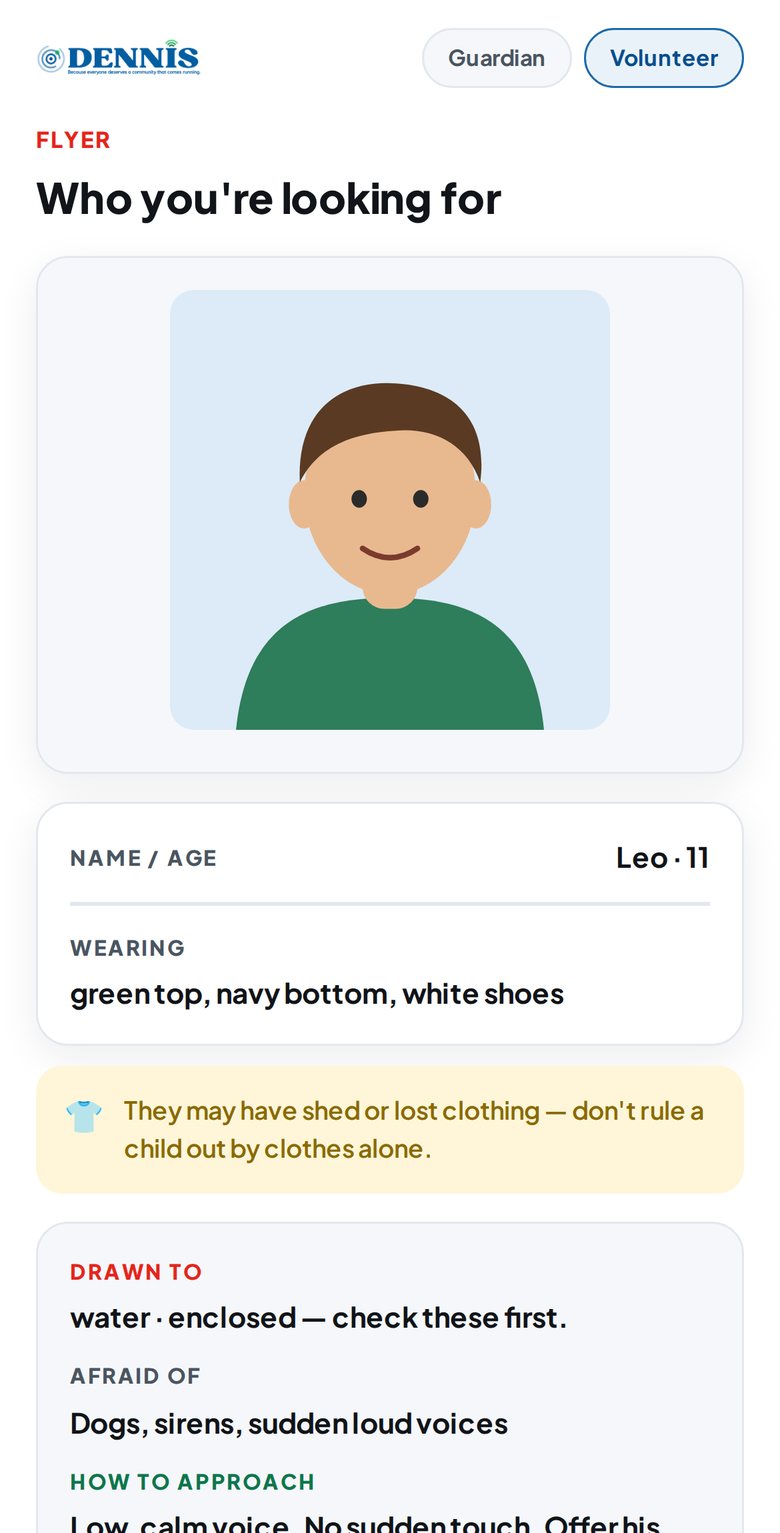
You know your person better than anyone. On a calm day, build their profile. When an alert goes out, it becomes the flyer every searcher reads, so the people looking for them know how to help, not just what they look like.

  • A current photo, nicknames, and identifying marks.
  • How they communicate: whether they will answer to their name, whether they speak, and what to look for instead.
  • What they are drawn to, like water, trains, roads, stores, or small enclosed spaces, so searchers check those first.
  • What frightens them, like dogs, sirens, or loud voices, and how to approach them in words you choose.
  • Medical details are shown only to first responders, never to volunteers. You can mark other fields responders-only too.

Sample data. The person shown is fictional.

The flyer a volunteer sees during a search, with the person's photo, what they are wearing, what they are drawn to, what frightens them, and how to approach them
If they go missing

One press. Three questions. Help is already moving.

  1. Press Elopement Alert and confirm. Start the search where you are, or from another place, like their school.
  2. Answer three quick questions: how long ago they left, what colors they are wearing (tap, do not type), and whether they are on foot, on a bike, or may be in a vehicle.
  3. Nearby verified volunteers are alerted with the flyer, and the search area widens on its own as time passes. Water, highways, and rail lines nearby make it widen faster.
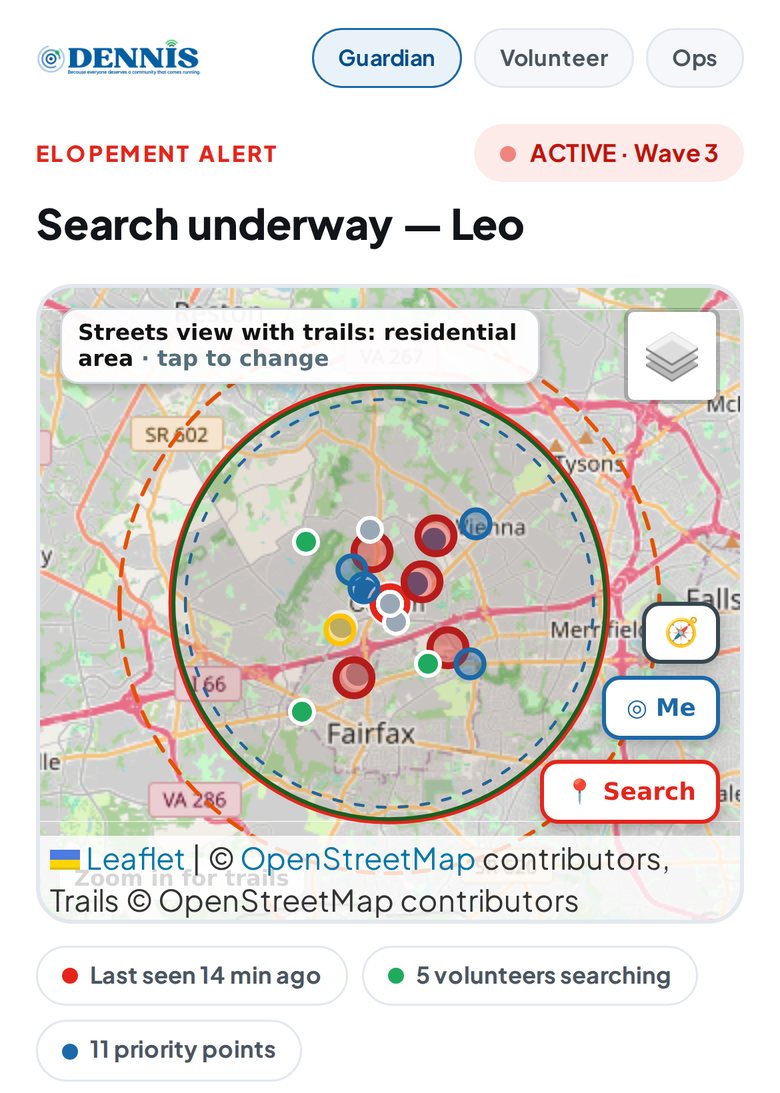
  4. Volunteers are sent to the places that matter first, and you watch every volunteer and every sighting on the live map.
  5. If your local agency uses DENNIS, first responders are notified as the search reaches them, and they can take command.
  6. Someone sees them? The sighting comes to you first to confirm. When they are safe, you mark them recovered and everyone stands down.
If someone is missing or in danger, call 911 first. DENNIS works alongside 911. It does not replace it.
The live search map a family sees during an active search, with search rings, volunteers, and priority points

The live map during a sample search: search rings, volunteers, and the priority points they are covering.

What it looks like

A Saturday afternoon, minute by minute.

Example
  1. 2:14 PM. Leo, 11, who is autistic and nonspeaking, slips out the back gate while his mom is helping his sister with homework.
  2. 2:15 PM. She opens DENNIS, taps Leo, and presses Elopement Alert. Three taps later: just now, green shirt, navy shorts, on foot.
  3. 2:16 PM. Volunteers within reach get his flyer: drawn to water, afraid of dogs and sirens, will not answer to his name, offer his headphones and say "Mom is coming." The nearest one is sent to the retention pond two streets over.
  4. 2:24 PM. A volunteer spots him at the edge of the pond, stays calm and at a distance, and taps Report a Sighting. His mom confirms the photo.
  5. 2:27 PM. She is there. She marks him safe, and every volunteer gets the word to stand down.
Illustrative example. Names and details are fictional.
The Assistance Alert

When the crisis is not a disappearance.

Some of the hardest moments happen when everyone is right there: a meltdown in a store that will not end, a teenager who is hitting and cannot stop, a grandfather with dementia who is frightened, confused, and fighting anyone who touches him, or trying to run. Many families hesitate to call for help in those moments, because they are afraid of how an encounter might go. The Assistance Alert is a separate service built for exactly this.

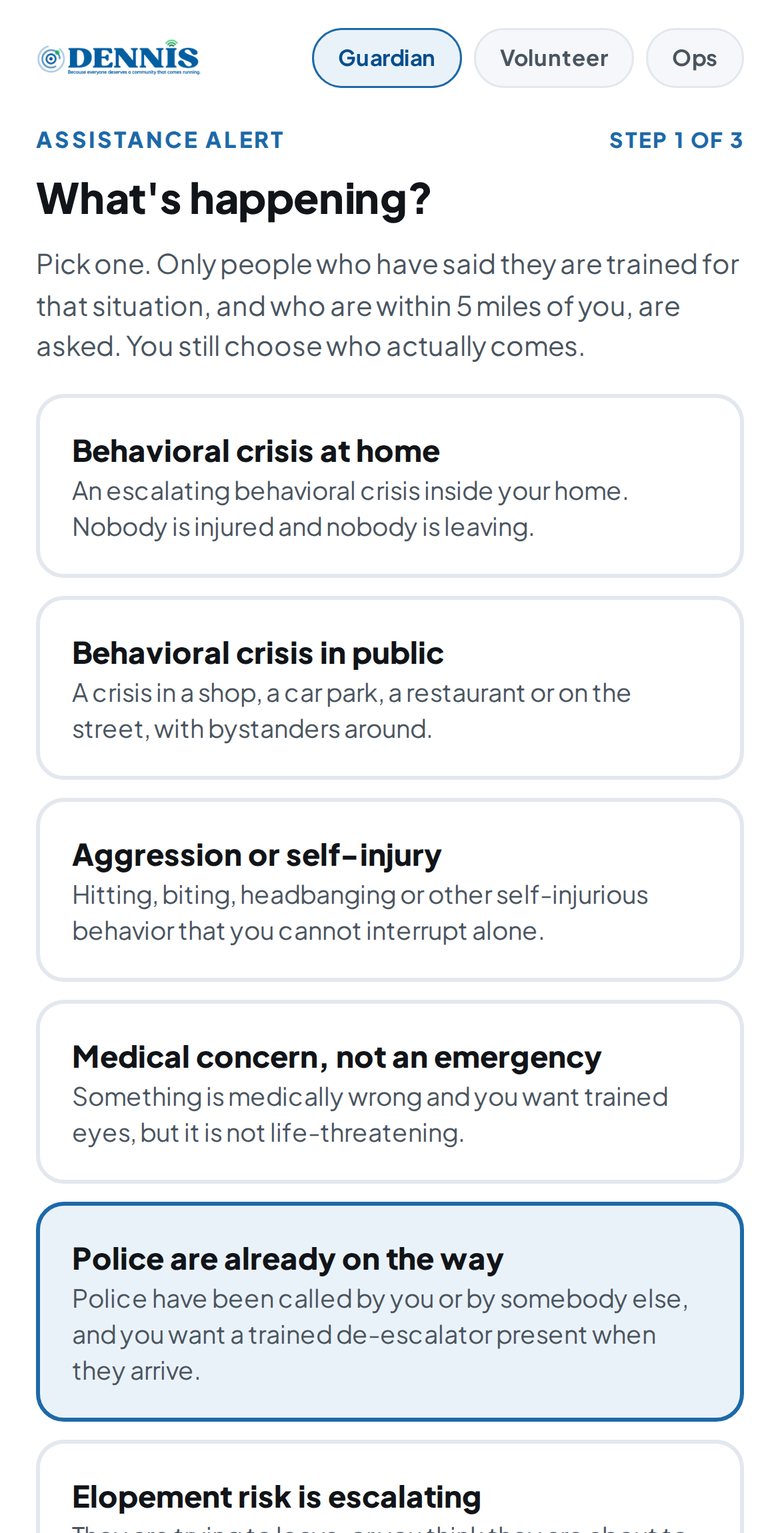
  1. Tell DENNIS what is happening. Pick the situation: a crisis at home or in public, aggression or self-injury, sensory overload, a medical concern that is not an emergency, elopement risk that is escalating, or police already on the way.
  2. Only verified helpers trained for that situation are asked, and only if they are within 5 miles. Helpers are first responders and licensed professionals whose credentials DENNIS has verified, such as behavior analysts, crisis counselors, nurses, EMTs, and Crisis Intervention Team (CIT) officers who have chosen to take Assistance Alerts.
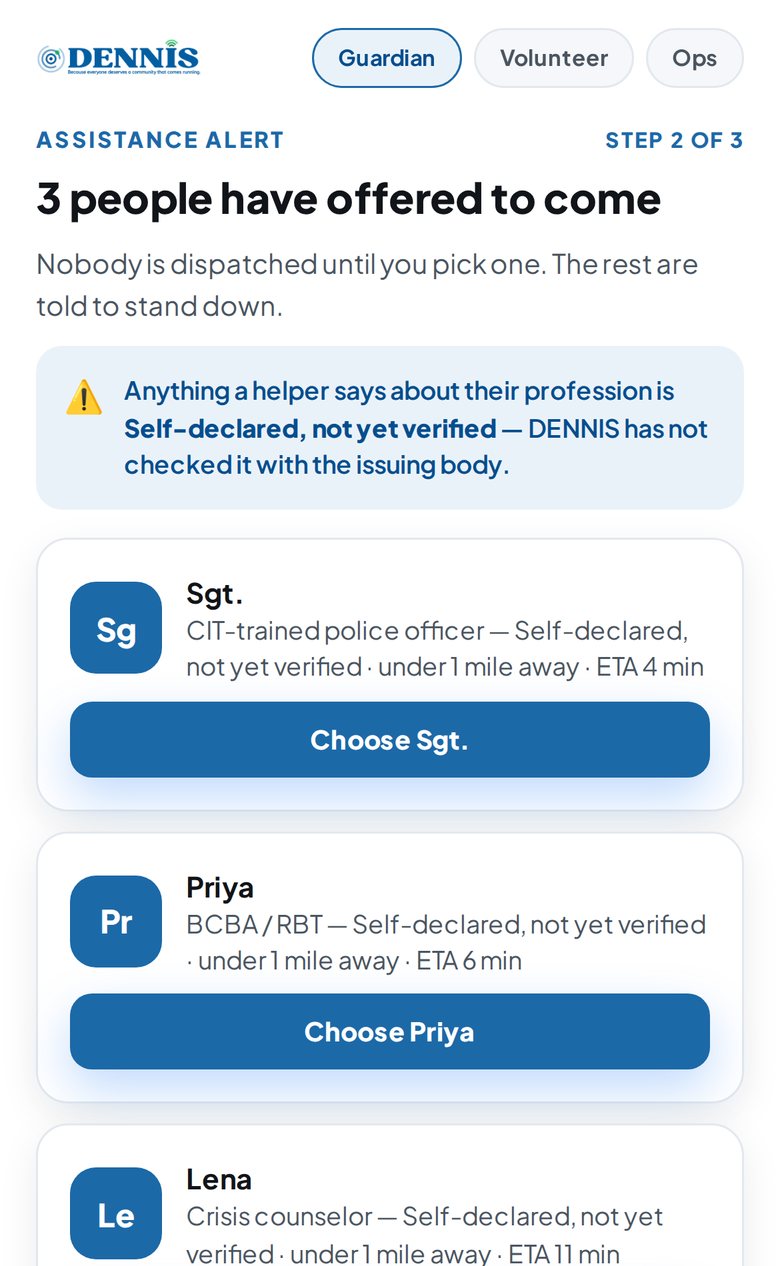
  3. You see who offered, their training, how far away they are, and how soon they can be there. Nobody comes until you choose.
  4. You choose one. Everyone else is thanked and released. The person you chose comes knowing your loved one's profile: how to talk to them, what calms them, and what to avoid.
  • If police are already on the way, the Assistance Alert brings a trained de-escalator to be there when they arrive.
  • It is available for autism, cognitive or developmental, dementia, and endangered adult profiles.
  • Every helper is an approved first responder or a licensed professional verified by DENNIS, so you always know who you are choosing.
If anyone is in immediate danger, or this is a medical emergency, call 911. The Assistance Alert is not an emergency service.
The first step of an Assistance Alert, where the family picks what is happening, such as Police are already on the way
The second step of an Assistance Alert, showing three trained helpers who offered to come, with their training and arrival times
Example
  1. 4:10 PM. Walter, 81, who has dementia, is frightened and confused at the grocery store. He has pushed a clerk and keeps trying to leave. The store has called the police.
  2. 4:11 PM. His daughter presses Assistance Alert and picks "Police are already on the way."
  3. 4:12 PM. Three people offer: a CIT-trained officer 4 minutes away, a behavior analyst 6 minutes away, and a crisis counselor. She chooses the officer.
  4. 4:16 PM. He arrives already knowing to call him Walt, not to grab his arm, and to talk about his years at the post office. Walter walks out to the car with his daughter.
Illustrative example. Names and details are fictional.
Your privacy, your control

Their information is shared only when it is needed.

Private until an alert

Volunteers do not browse profiles. A flyer is shown to searchers only while a search for that person is active.

Responders see more

Medical details go to first responders only. You can mark any other field responders-only as well.

Trusted places

You will be able to let your child's school start a search party while they are in its care, and you are notified the moment it does. School-started searches are in field testing.

Questions families ask

Good to know.

Does DENNIS cost anything?

No. Every emergency feature, including the Elopement Alert, the Missing Person Alert, and the Assistance Alert, is free for every family, always. DENNIS+, coming soon, is an optional paid membership for everyday organizing, and it will never gate an alert.

Do I still call 911?

Yes. If someone is missing or in danger, call 911 first. DENNIS works alongside 911 and first responders by putting organized, informed neighbors on the ground at the same time. It is not an emergency service, and it does not call 911 for you.

Does my loved one need a diagnosis?

No. If someone you love could go missing or go into crisis, they belong in DENNIS.

Who are the volunteers?

Neighbors who sign up and, before they can join a live search, complete identity verification and a background check. They accept a safety acknowledgment for every search. They are told they are spotters, not rescuers, and they are alerted only when they are close enough to help.

Is DENNIS available now?

The DENNIS emergency features are in field testing with volunteer testers using sample profiles. Sign up to join testing, and search access opens in each community as volunteers sign up.

Everyday life, too · Coming soon

DENNIS+ will help with the rest of the week.

Coming soon: a paid membership that adds a life organizer and written guides. Appointments, to-dos, and the guidance you need, in one calm place. Emergency alerts and volunteer search stay free whether or not you join.

Learn more about DENNIS+ →

You don't have to carry this alone anymore.

Register your family today and help us build the safety net every caregiver deserves.

Sources for the figures on this page

  1. Anderson et al., Occurrence and Family Impact of Elopement in Children With Autism Spectrum Disorders, Pediatrics, 2012 (summary by the federal Interagency Autism Coordinating Committee). Source
  2. National Autism Association, Mortality and Risk in ASD Wandering/Elopement, 2011 to 2016 (documented cases). Source
  3. Alzheimer's Association, Wandering. Source
  4. Koester and Stooksbury, Behavioral profile of possible Alzheimer's disease patients in Virginia search and rescue incidents, Wilderness and Environmental Medicine, 1995. Source
  5. Rowe et al., Persons with dementia missing in the community: is it wandering or something unique?, BMC Geriatrics, 2011. Source

Screens shown are from the DENNIS app in field testing, using sample data. Names, people, and places in screenshots and examples are fictional.