
TESTING IS UNDERWAY. SIGN UP TO HELP TEST THE SOFTWARE →
For Volunteers

Be the neighbor who helps bring them home.

When a child or an adult with dementia goes missing, the people already nearby are often the fastest help there is. DENNIS helps caring neighbors search together, organized and screened, and tells you exactly who to look for, where to go, and how to help safely.

Why neighbors matter

Most people who wander are found close to where they started.

That is why the people already in the neighborhood matter so much. You can be looking within minutes, long before an organized search is fully on scene.

53%of people with dementia who left on foot were found within 1 mile. Half of those found dead were within half a mile.Rowe et al., BMC Geriatrics, 2011
46%of people with dementia who were not found within 24 hours had died, in one Virginia search and rescue study.Koester and Stooksbury, 1995
41 minwas the average time autistic children who wandered were missing. 65% had a close call with traffic and 24% with drowning.Pediatrics, 2012
1 in 31U.S. children has been identified with autism. Some of them live on your street.CDC, 2025
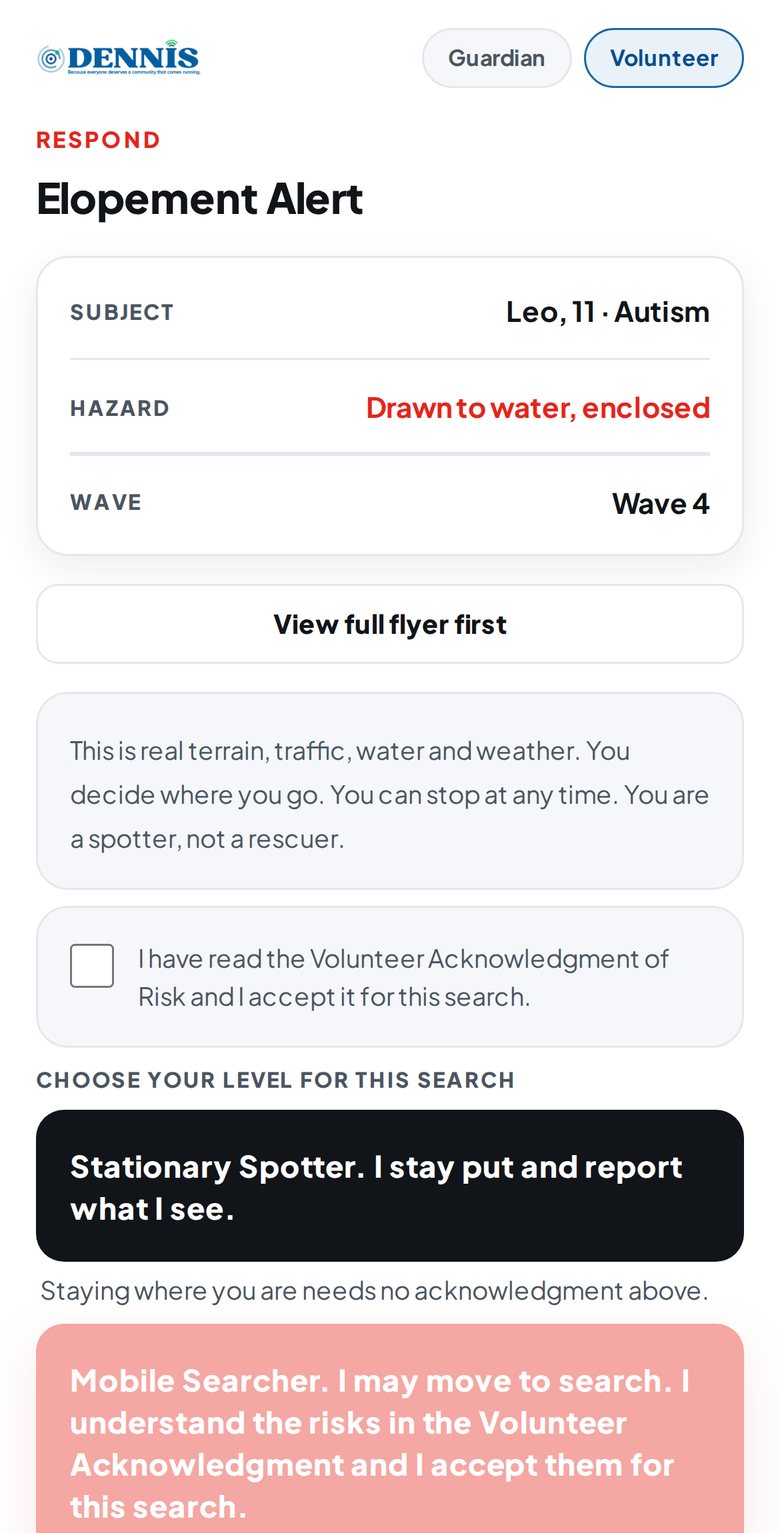
The volunteer response screen for an Elopement Alert, showing who is missing, the nearby hazards, and the choice of how to help
When an alert reaches you

You decide how you help, every time.

Alerts reach you only when you are close enough to help. You see who is missing, the hazards nearby, and their full flyer before you commit. Then you choose your level for this search.

Stationary Spotter

Stay where you are and watch. Perfect from a porch, a parking lot, or a store counter.

Mobile Searcher

Move to search and take an assignment. How you get there is up to you.

Certified Searcher

For volunteers with verified search and rescue or tracking credentials.

Can't go right now? Ask to be reminded in 15 minutes, an hour, or later. A search that is still going will still need you.

Sample data. The person shown is fictional.

On the search

You will never be wandering around guessing.

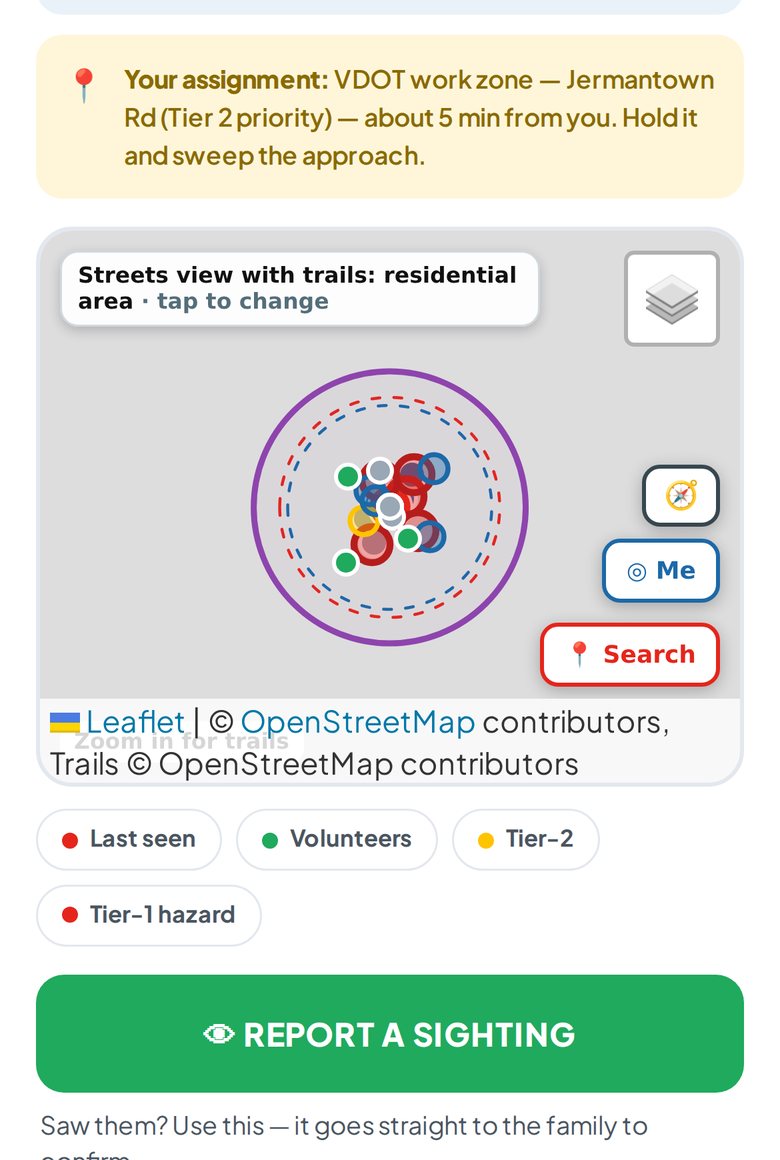
DENNIS gives you an assignment: a place to go and what to do there, starting with the spots the person is most drawn to and the hazards nearest to where they were last seen, like water, roads, and rail lines. The live map shows where everyone else is, so no ground is wasted.

  • Report a Sighting with a photo. It goes straight to the family to confirm.
  • Log an observation, like a dropped shoe or a sound you heard, and first responders are flagged.
  • Talk to command. The person running the search can message everyone, or you directly, and redirect you to a new spot.
  • Read the flyer any time: how they communicate, what frightens them, and how to approach them.

Sample data. The person shown is fictional.

A volunteer's search screen with an assignment, the live map, and a large Report a Sighting button
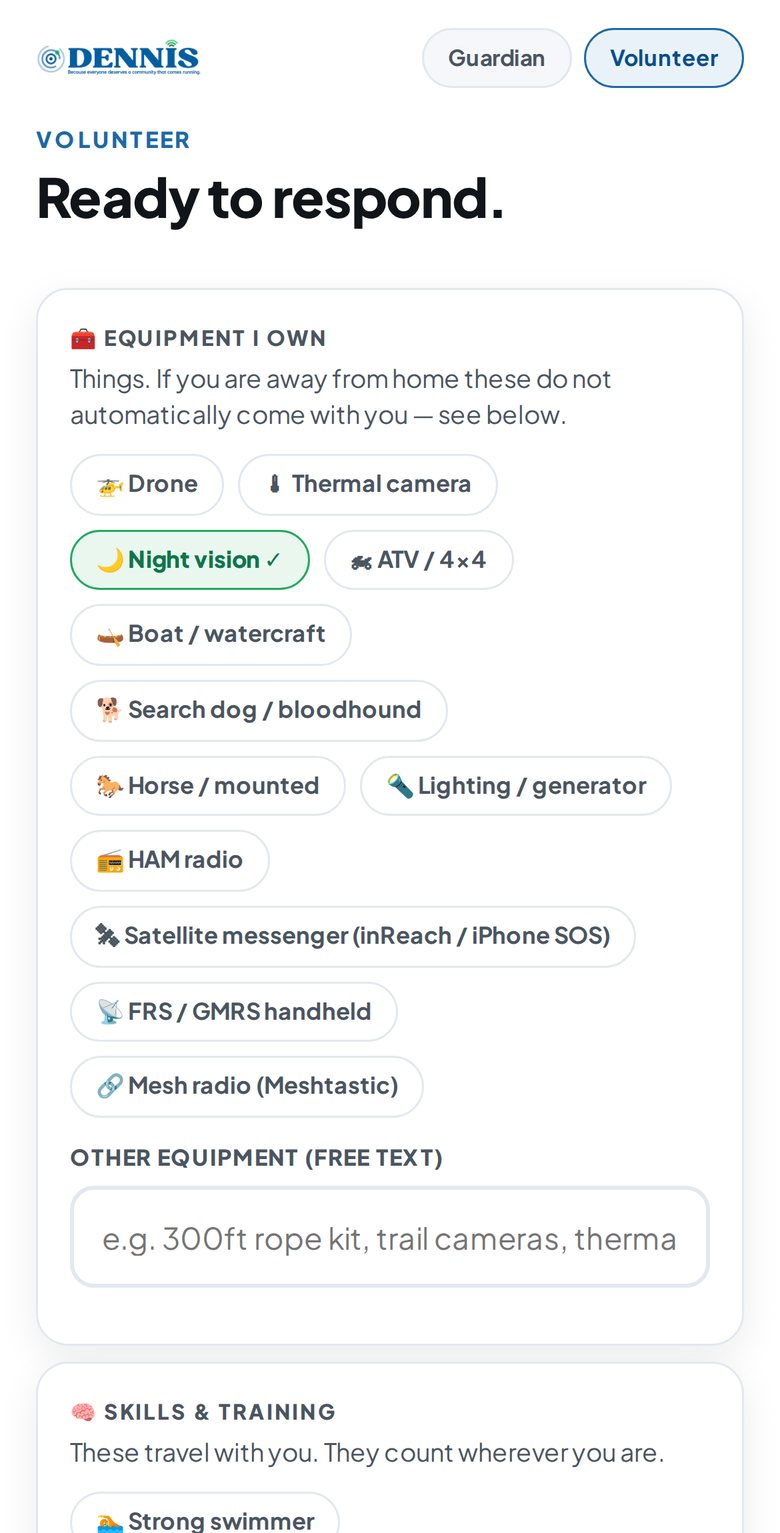
The volunteer profile where you list equipment you own, skills and training, and professional roles
Your skills and equipment

Tell us what you bring. Command can call on it.

Every volunteer is useful. Some bring something a search can't get any other way. When you sign up, list what you have, and when a search needs it, command can call on you directly.

  • Equipment: drones, thermal cameras, night vision, boats, ATVs, search dogs, horses, lighting, and radios.
  • Skills and training: strong swimmer, wilderness first aid, CPR, search and rescue, tracking, sign language, and training or experience with autism, Alzheimer's, or other neurological disabilities.
  • Professional roles: EMTs, nurses, firefighters, police officers, dispatchers, and search and rescue team members.
  • Your limits: how far you will travel, and where your equipment actually lives, so nobody counts on a drone that is sitting in your garage.
Your safety comes first

You are a spotter, not a rescuer.

Clear rules

Do not enter water, traffic, or unstable ground. If something feels unsafe, it is: report it and step back. You can stop at any time.

Your choice, every search

You read and accept a short safety acknowledgment for each search, and you choose your level each time. Nothing carries over without your say.

A silent way to call for help

A press-and-hold duress button lets you signal command quietly if you are ever in danger yourself.

For trained volunteers

Trained in de-escalation? You can answer Assistance Alerts too.

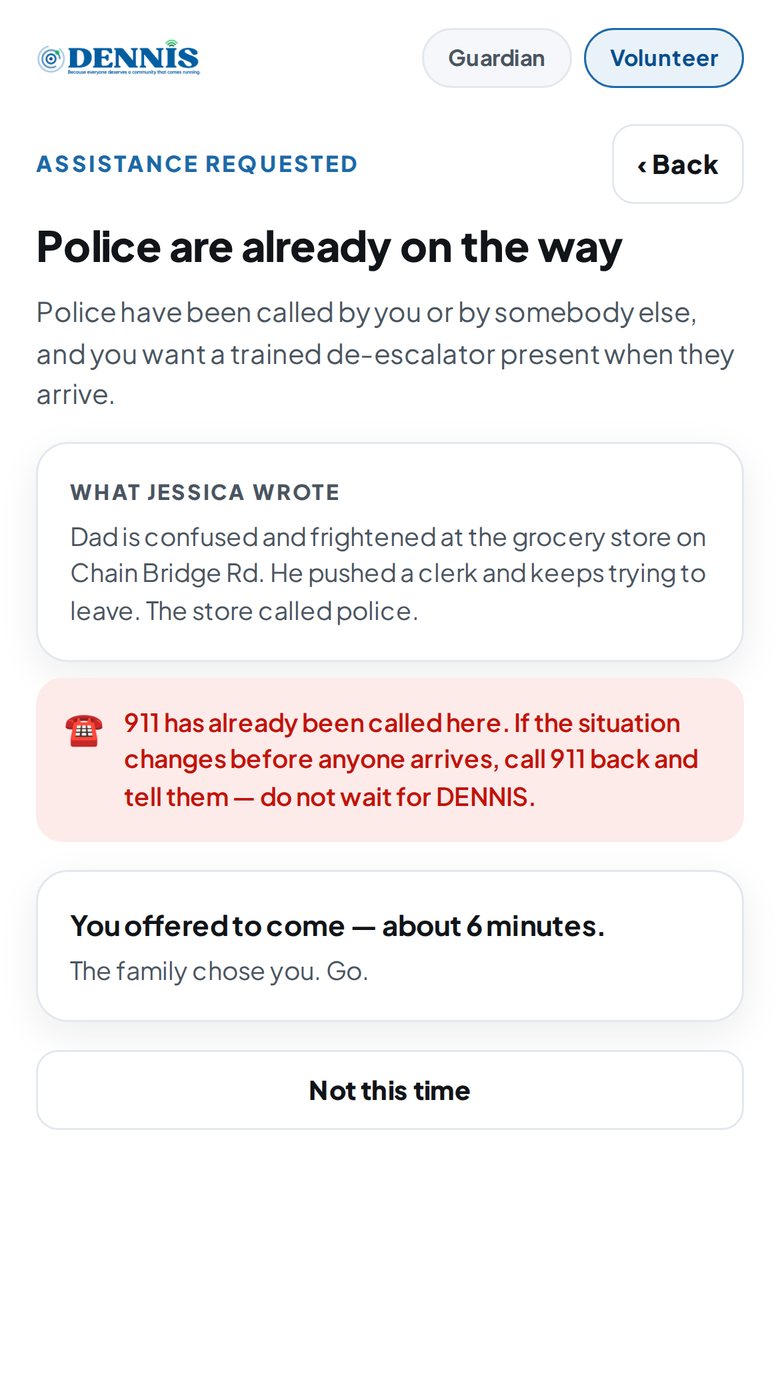
Behavior analysts, RBTs, crisis counselors, nurses, EMTs, social workers, and CIT-trained officers can answer once DENNIS has verified their license, certification, or responder status. You tell DENNIS which crisis situations you are trained for. When a family nearby needs that kind of help, you are asked. You see what the family wrote, and you offer to come with your arrival time. The family chooses one helper, and everyone else is released with thanks.

  • You are asked only for the situations you said you are trained for, and only within about 5 miles.
  • Nobody is dispatched by answering. You go only if the family chooses you.
  • If what you find is an emergency, you call 911 yourself.
An Assistance Alert request as a trained helper sees it, with what the family wrote and the choice to offer to come
What it looks like

Ten minutes that matter.

Example
  1. 6:40 PM. Your phone buzzes: Missing Person Alert, 0.4 miles away. Walter, 81, who lives with Alzheimer's, left home on foot.
  2. 6:41 PM. You read his flyer and a note from his daughter: "He may think he's walking to his old office. Call him Walt, and don't rush him."
  3. 6:43 PM. You choose Mobile Searcher. DENNIS sends you to the bus stops along the main road, the route to the office he used to work at.
  4. 6:52 PM. You find him at the second stop, sit down beside him, tap Report a Sighting, and talk about his old job until his daughter arrives.
Illustrative example. Names and details are fictional.
How to get ready

Four steps, and you're ready to help.

1. Sign up

Tell us where you live, how far you will travel, and the skills, training, and equipment you bring.

2. Get verified

Complete identity verification and a background check. Families are trusting you with the person they love most, and this is how we earn that trust. Sponsors in your county help cover the cost.

3. Complete orientation

A required orientation of about 20 minutes covers your role, searching for a profoundly autistic person, protecting the scene and evidence, your safety, and what stays private. There is no test and no score: a wrong answer shows you why, and you try again. No alerts reach you until it is done.

4. Answer the alert

When someone goes missing near you, join with one tap and follow the guidance on screen. Links to local search and rescue courses are in the app's Learn tab.

Search access opens in each community as enough volunteers sign up. The more neighbors who join, the sooner your community is covered.

Volunteer Onboarding

Your community needs you closer than you think.

Sign up today. The next alert could be on your street.

SMS Disclosure. If you check the SMS consent box on the form above, you agree to receive text messages from Find With Dennis LLC about onboarding, coordination, and program updates. Consent is optional and is not a condition of any purchase or of using any DENNIS service. Message frequency varies. Message and data rates may apply. Reply STOP to unsubscribe at any time, or reply HELP for assistance. Text messaging originator opt-in data and consent will not be shared with any third parties, excluding aggregators and providers of the text message services. See our Terms & Conditions and Privacy Policy.

Sources for the figures on this page

  1. Rowe et al., Persons with dementia missing in the community: is it wandering or something unique?, BMC Geriatrics, 2011. Source
  2. Koester and Stooksbury, Behavioral profile of possible Alzheimer's disease patients in Virginia search and rescue incidents, Wilderness and Environmental Medicine, 1995. Source
  3. Anderson et al., Occurrence and Family Impact of Elopement in Children With Autism Spectrum Disorders, Pediatrics, 2012 (summary by the federal Interagency Autism Coordinating Committee). Source
  4. CDC, Autism and Developmental Disabilities Monitoring Network, 2022 data (published 2025). Source

Screens shown are from the DENNIS app in field testing, using sample data. Names, people, and places in screenshots and examples are fictional.