
TESTING IS UNDERWAY. SIGN UP TO HELP TEST THE SOFTWARE →
Watch: Find With Dennis for First Responders (2:54)
For First Responders

A community search party, under your command.

DENNIS does not compete with or replace first responders. It is a force multiplier: law enforcement, fire, EMS, and search and rescue get the person's profile, a live picture of the search, and screened volunteers who are already organized and waiting for direction. You can take over a search already underway, or start your own.

Police
Fire
EMS
Dispatch
SAR
The people you serve

These calls are common, and they can go wrong fast.

1 in 5young people with autism had been stopped and questioned by police by age 21. Nearly 5% had been arrested.Rava et al., 2017
49%of autistic children try to wander or bolt from a safe place. Many are drawn to water and traffic.Pediatrics, 2012
46%of people with dementia not found within 24 hours had died, in one Virginia search and rescue study.Koester and Stooksbury, 1995
2xCIT-trained officers were about twice as likely to resolve a mental health encounter by talking, and more likely to connect the person to services.Compton et al., Psychiatric Services, 2014
Your dashboard and command center

Every search in your jurisdiction, on one screen.

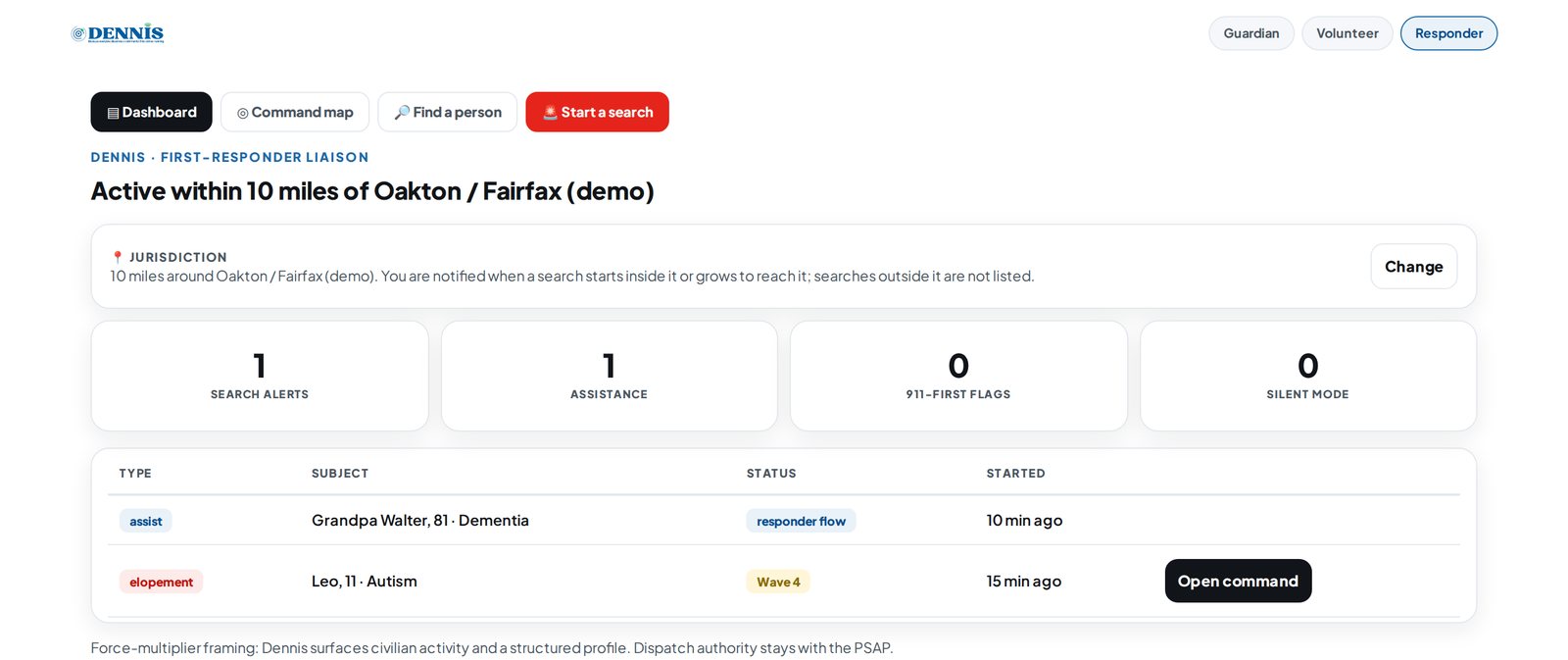
Your agency gets its own responder console. You are notified when a search starts inside your response area, or grows to reach it, and you see only the searches in your own jurisdiction.

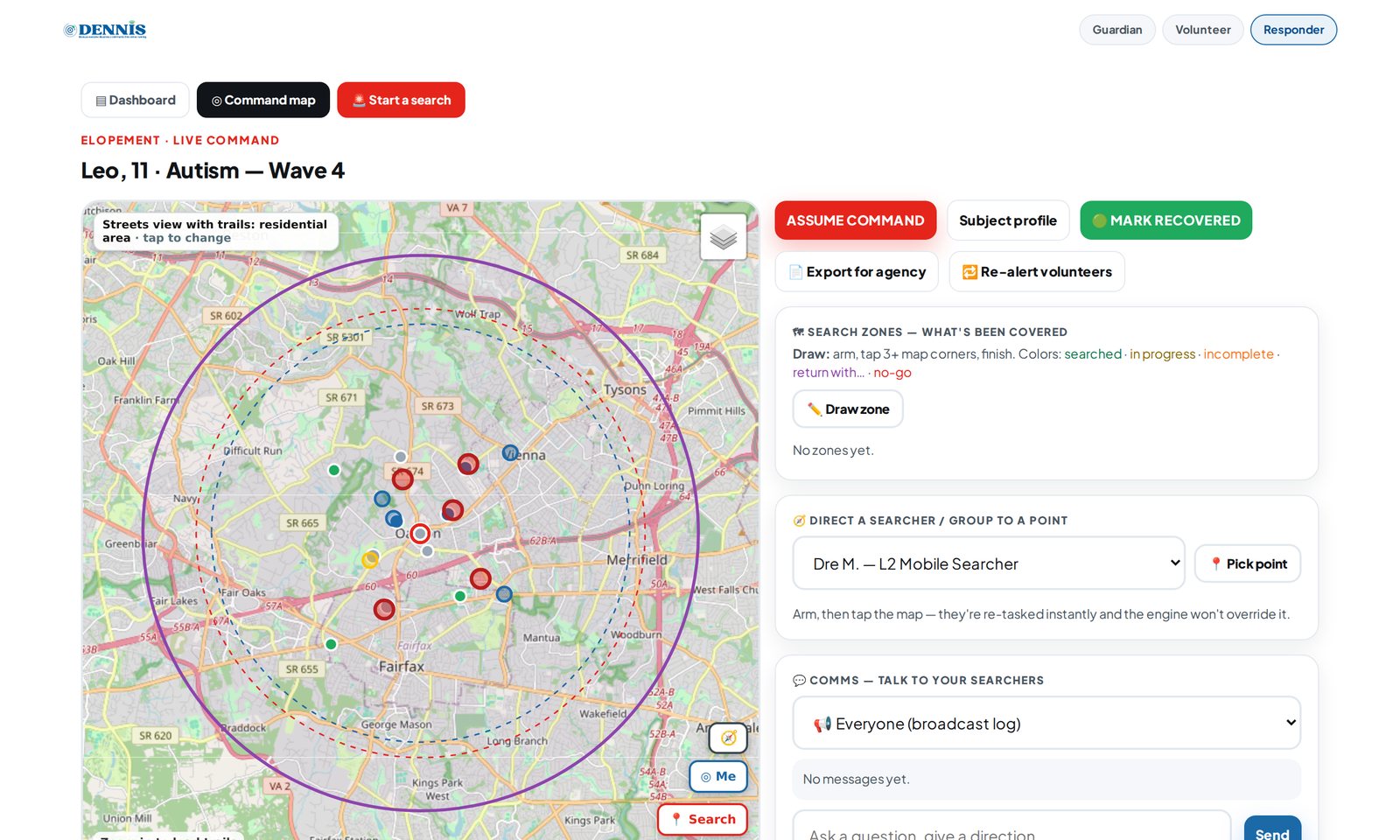
The DENNIS responder command map for an active search, with search rings, volunteer positions, and buttons to assume command, export records, and re-alert volunteers

The command map during a sample search: search rings, volunteers, sightings, and command tools.

Assume command

Take over a search the family started with one tap. Incident command stays with you, and only approved responders can close a search.

Direct the search party

Send one directive to everyone, message a single volunteer, or send a person or a whole capability group, like every drone or K9 team, to a point on the map. They are re-tasked instantly.

See what is covered

Draw search zones and mark them searched, in progress, or no-go. Plot the last known point, command post, and staging. Every volunteer and sighting updates live.

Call on community resources

The capability roster shows who in the search can bring a drone, thermal camera, night vision, boat, strong swimmer, K9, horse, ATV, radio, or medical training. Tap to call on them.

Re-alert and widen

Re-alert volunteers when you need more hands. The search area also widens on its own as time passes, faster near water, highways, rail lines, and after dark.

Records for follow-up

Export a record of the search for your agency, including the timeline and sightings, to support reports and investigations.

The DENNIS responder dashboard listing active searches and assistance requests in the agency's jurisdiction

The responder dashboard: active searches, assistance requests, and your jurisdiction.

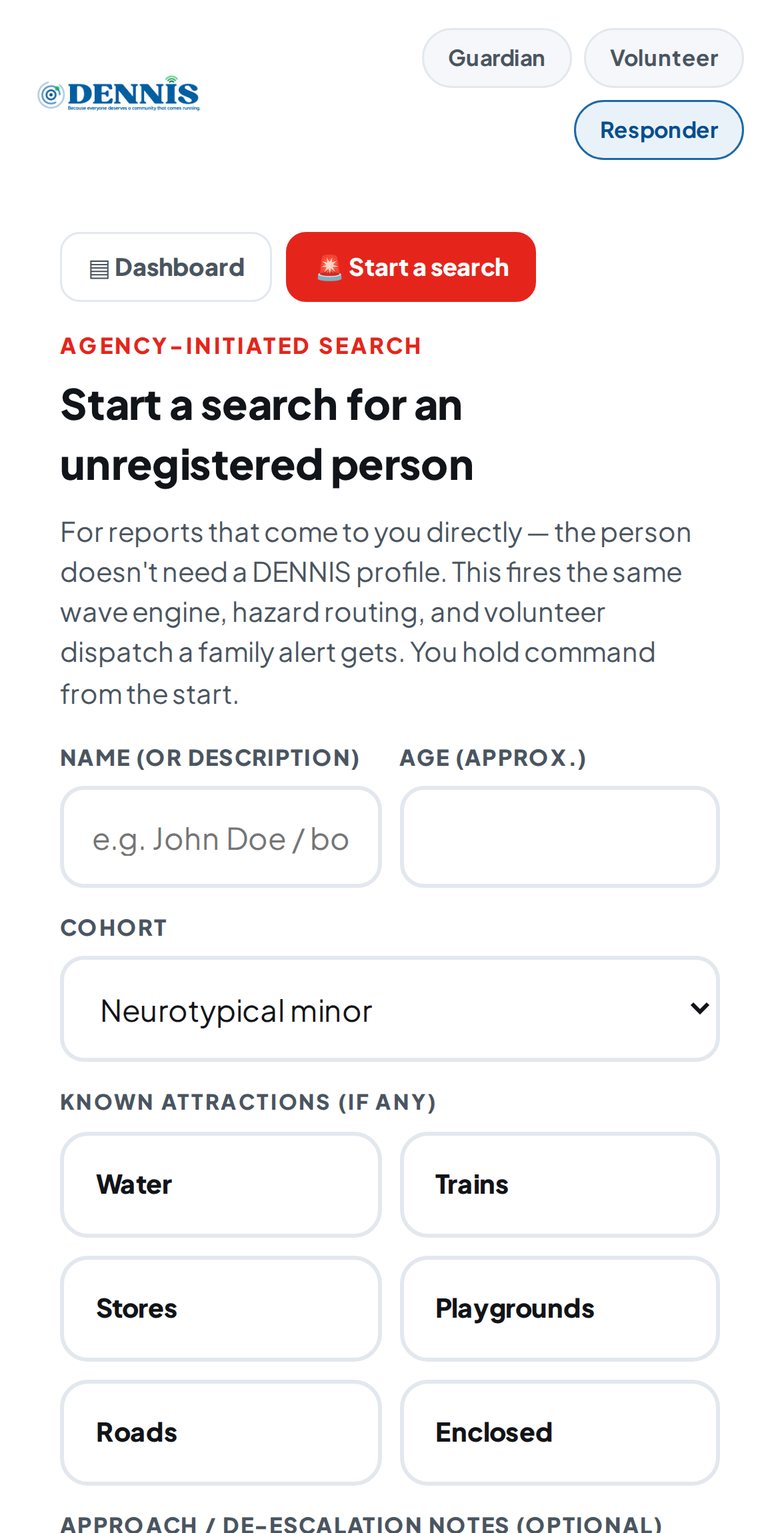
The agency-initiated search form, used to start a search for someone who does not have a DENNIS profile
Start your own search party

A report comes to you first? Call on the community yourself.

Not every missing person has a DENNIS profile. When a report comes to you directly, start an agency-initiated search for anyone in your community who needs to be found. Enter a name or description, approximate age, what they are drawn to, approach notes, and the last known location.

  • The same search engine a family alert gets: hazard routing, widening search areas, and nearby screened volunteers dispatched with assignments.
  • You hold command from the first second.
  • Call on the volunteers' skills and equipment from the capability roster.
  • Run it as a labeled training exercise for drills, so nobody mistakes practice for a real search.
Found someone who can't tell you who they are?

Get them home, even when nobody has reported them missing yet.

You are with someone who is nonspeaking, confused, or lost, and cannot say who they are or where they live. Approved responder accounts can check the person against the DENNIS family profile network to find their family and get them home.

  • Works even when the family did not start a search, and even when they live in another county.
  • Every lookup is logged.
Arrive informed

Know who you are walking up to.

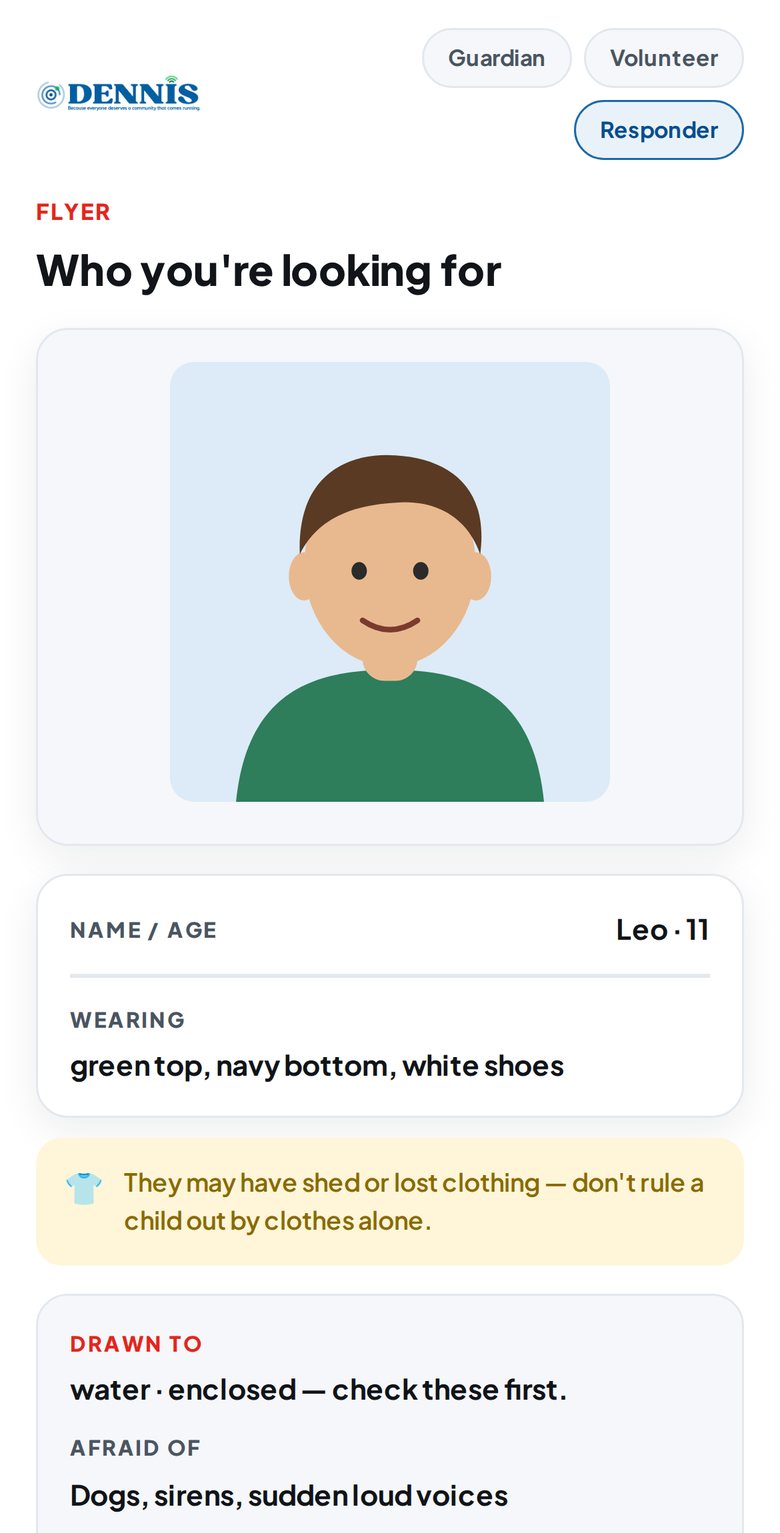
Before you get there, you see the profile the family built: photo, how they communicate, what they are drawn to, what frightens them, and how to approach them. Medical details are shown to first responders only, never to volunteers.

  • Know if they will not answer to their name, or will run from sirens.
  • Know the de-escalation words that work for this person.
The Assistance Alert

Bridging the gap between police and the families who are afraid to call.

Many families of autistic children and adults, and of people with dementia, hesitate to call for help in a crisis because they are afraid an encounter could escalate and someone could be hurt. So they wait, and the crisis grows. The Assistance Alert gives those families a way to ask for trained help, and gives your officers a way to arrive prepared.

  1. The family describes the situation: a behavioral crisis at home or in public, aggression or self-injury, sensory overload, escalating elopement risk, or police already on the way.
  2. CIT-trained officers who opt in receive Assistance Alerts in their own jurisdiction, for the situations they are trained for, alongside verified behavior analysts, crisis counselors, and medics.
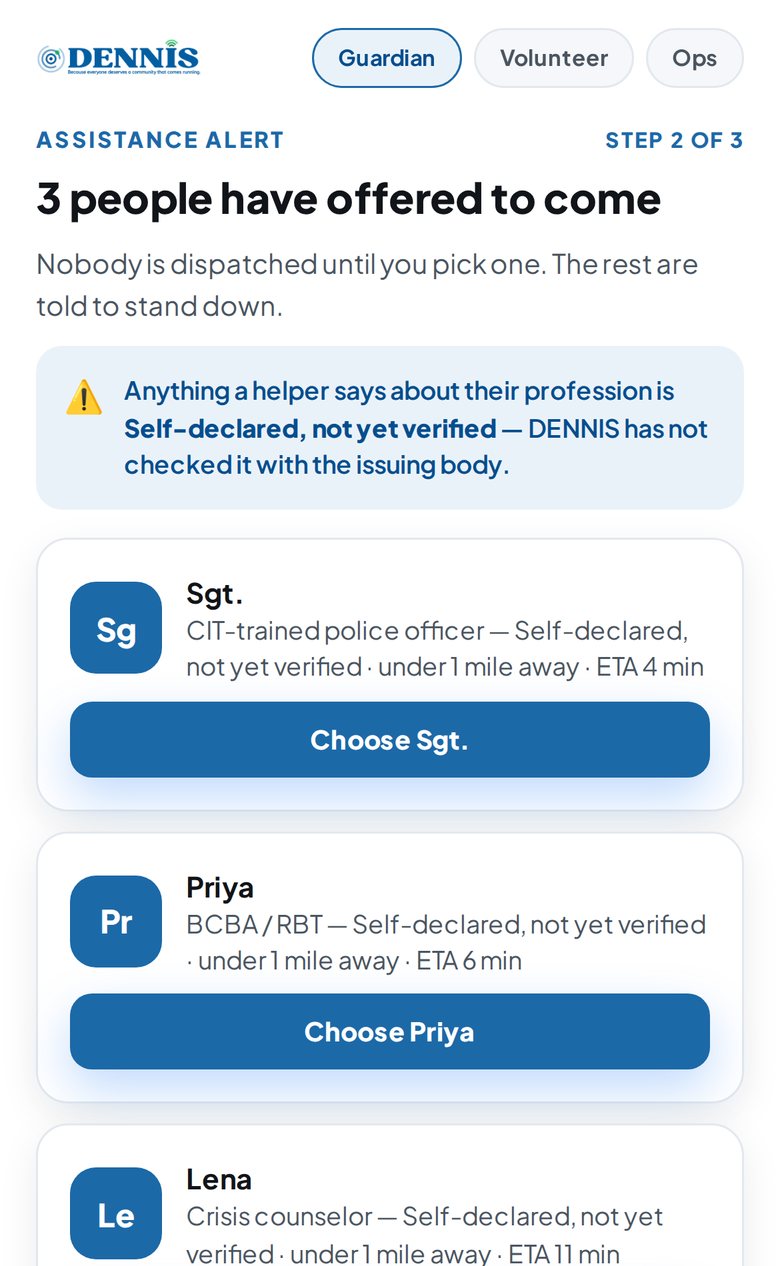
  3. You offer, with your arrival time. The family sees your training and chooses who comes.
  4. You arrive with the profile in hand: communication, triggers, sensory needs, what calms them, and medical details, so you know exactly what you are walking into.
  • When police are already on the way, the family can ask for a trained de-escalator to be there when officers arrive.
  • Fewer surprises at the door means safer encounters for the person, the family, and your officers.
The family's view of an Assistance Alert, showing a CIT-trained officer, a behavior analyst, and a crisis counselor who offered to come

What the family sees: trained helpers who offered, their training, and their arrival times. Sample data.

Built to fit how you already work

Clear lines, so it helps and never gets in the way.

  • It does not replace 911 or dispatch. Families are told to call 911 first.
  • Incident command stays with you. Only approved responders can close a search.
  • Jurisdiction only. Each agency sees the searches in its own response area. A neighboring agency is brought in when a search moves toward it.
  • Not an alert authority. DENNIS works alongside AMBER Alert, Silver Alert, and state programs, coordinating the ground response.
  • Screened volunteers. Volunteers must complete identity verification and a background check before joining a live search, and accept a safety acknowledgment for every search.
  • No cost to your agency to receive alerts and take part.
The subject profile a responder sees, with photo, clothing, what the person is drawn to, what frightens them, and how to approach them
What it looks like

A call that starts with answers.

Example
  1. Dispatch. A mother reports her 14-year-old autistic son missing from a park. Before units arrive, her DENNIS alert is already active and 12 volunteers are searching.
  2. En route. The responding officer opens the profile: nonspeaking, afraid of sirens, drawn to trains, may hide in small spaces. Lights stay on, sirens stay off.
  3. On scene. The officer assumes command. Volunteers have already covered the playground and parking lots. One message sends the two volunteers with drones to the rail corridor and everyone else to the culverts along the creek.
  4. Found. A volunteer spots him behind a utility shed near the tracks and reports the sighting. The officer approaches quietly, and he is reunited with his mother without a struggle.
Illustrative example. Names and details are fictional.
Book a Call

Let's bring them home together.

DENNIS is in field testing now. Pick a time for a 30-minute call with our founder. We'll walk through the responder console, how it fits your jurisdiction, and what testing it with your agency looks like.

Rather send details first? Use the agency form. Government offices and Community Services Boards, start here.

Agency Onboarding

Connect your agency.

SMS Disclosure. If you check the SMS consent box on the form above, you agree to receive text messages from Find With Dennis LLC about onboarding, coordination, and program updates. Consent is optional and is not a condition of any purchase or of using any DENNIS service. Message frequency varies. Message and data rates may apply. Reply STOP to unsubscribe at any time, or reply HELP for assistance. Text messaging originator opt-in data and consent will not be shared with any third parties, excluding aggregators and providers of the text message services. See our Terms & Conditions and Privacy Policy.

Sources for the figures on this page

  1. Rava et al., The Prevalence and Correlates of Involvement in the Criminal Justice System Among Youth on the Autism Spectrum, Journal of Autism and Developmental Disorders, 2017. Source
  2. Anderson et al., Occurrence and Family Impact of Elopement in Children With Autism Spectrum Disorders, Pediatrics, 2012 (summary by the federal Interagency Autism Coordinating Committee). Source
  3. Koester and Stooksbury, Behavioral profile of possible Alzheimer's disease patients in Virginia search and rescue incidents, Wilderness and Environmental Medicine, 1995. Source
  4. Compton et al., The Police-Based Crisis Intervention Team (CIT) Model: II. Effects on Level of Force and Resolution, Referral, and Arrest, Psychiatric Services, 2014. Source

Screens shown are from the DENNIS app in field testing, using sample data. Names, people, and places in screenshots and examples are fictional.